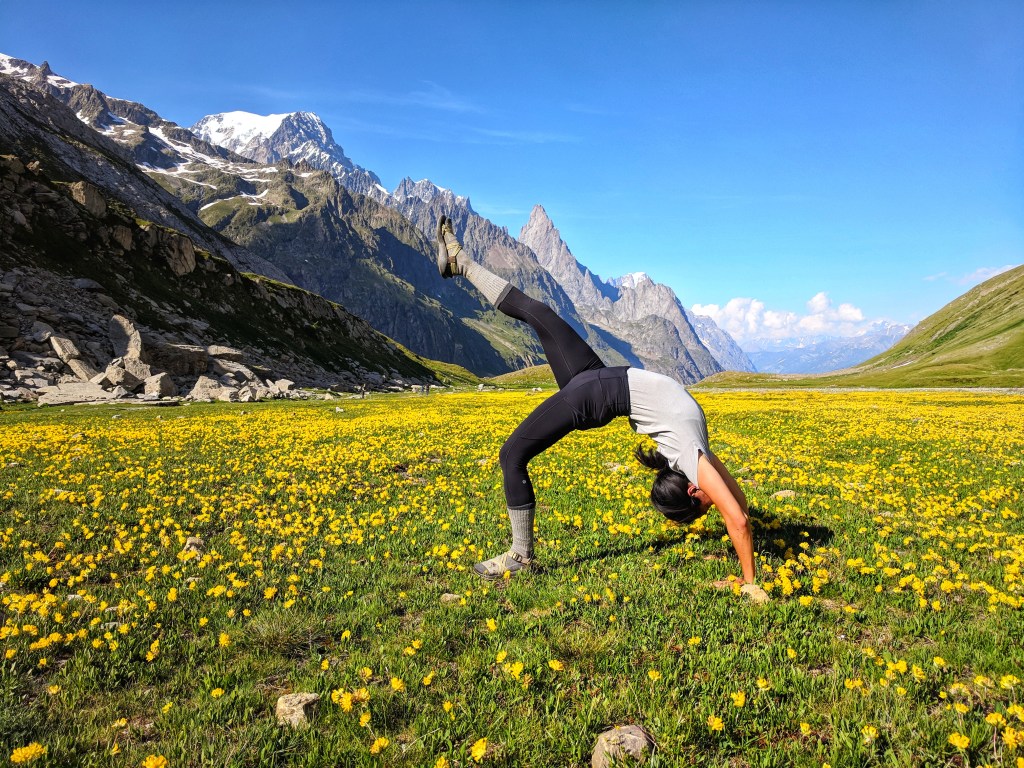
Wheel Pose (Chakrasana) is a powerful backbend and inversion that resembles the shape of a wheel. This pose is also sometimes referred to as Urdhva Dhanurasana in Sanskrit, or Upward Facing Bow. Chakrasana is an energizing pose that is often offered at the end of class as it requires warming up to be done safely for most people. It is a strengthening pose for the arms, legs, and back that also requires significant mobility and flexibility in the wrists, shoulders, and back.
Benefits & Muscle Focus
- Strengthens muscles the shoulders, legs, and back which are required for stability in this pose.
- Stretches muscles at the front of the body, including the hip flexors and pectoralis major muscles. The deep spinal extension also promotes spinal mobility and flexibility.
- Can be energizing and uplifting as it is a very active pose and an inversion, in which the heart is below the hips.
Alignment
- Start laying on your back with knees bent and feet flat on the floor, approximately hip- or shoulder-width apart.
- Place your hands beside your head approximately shoulder distance apart, with fingers pointing towards your shoulders. Depending on your shoulder mobility, hands can be placed right above the shoulder or next to the ears. For those attempting this pose for the first time or those with tight shoulders, aim to align the fingertips with the tops of the ears or higher.
- Press strongly into your feet and hands as you begin to lift the hips, then chest, and head. Once the chest and hips and lifted, begin to straighten your arms and legs, maintaining engagement throughout the legs, back, and shoulders.
- Keep your head between your arms with your gaze directed away from the body or between the hands. Hold for several breaths.
- To exit the pose, tuck the chin in towards your chest as you bend the arms and legs to slowly lower onto your back. Avoid immediately drawing your knees in towards your chest and opt for a few breaths in a neutral spine position (windshield wiper the legs or Supta Baddha Konasana (Reclined Bound Angle Pose) before flexing the spine.
- Counter this pose with a spinal twist.
- Modifications: add a block between the thighs to help maintain leg muscle engagement, amplify by lifting one leg or walking the feet towards the hands.
Contraindications
- Wrist injury or pain: This pose can put a lot of stress on the wrists; modify with either Bridge Pose (Setu Bandha Sarvangasana) or Forearm wheel (Dwipada Viparita Dandasana).
- Shoulder injury: Those with shoulder injuries should avoid this pose and opt for a more supportive backbend.
- Spinal problems: Individuals with herniated discs, spinal stenosis, or other serious back conditions should avoid deep backbends.
- Heart conditions: Those with heart conditions or high blood pressure should proceed with caution or avoid deep backbends that can increase the heart rate.
Practice


 The Power Yoga Podcast