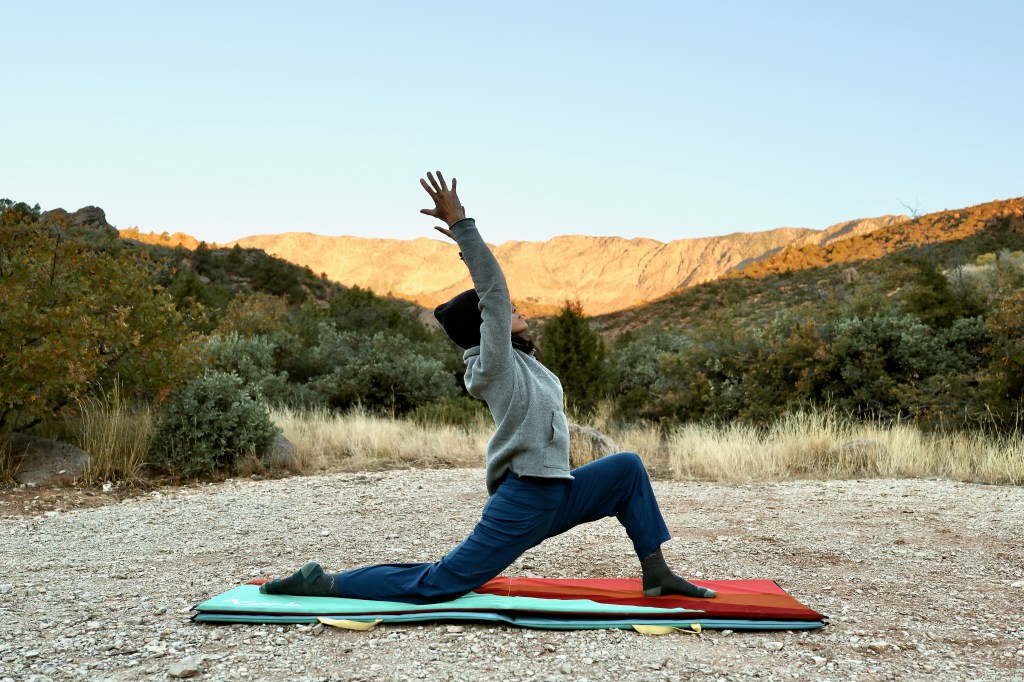
The yoga pose Anjanyeasana, also referred to as low crescent lunge, is named after the Hindu diety Anjaneya who was later renamed Hanuman. There are several myths surrounding the birth of Anjaneya, with the most widely accepted story being he was born to Anjana, a celestial nymph, and Vayu, god of the wind.
The pose originates from a story when Anjaneya gazes upward towards the sun and mistakes it for a mango, attempting to take a bite out of it. This upsets the sun god, Surya, who then takes the life of Anjaneya with a lightening bolt.
After finding out about the death of his son, Vayu sucks all of the air out of the earth. The gods come to a compromise and Anjaneya is brought back to life as half-man, half-monkey, and is re-named Hanuman, the monkey god.
Benefits & Muscle Focus
- Stretches the anterior hip, including the quad and hip flexor.
- Engages the abdominals and glutes to posteriorly tilt the pelvis.
- Opens the chest and enhances spinal flexbility in the backbend variation.
Alignment
- Starting from table top or downward facing dog, step the left foot between the hands ensuring the knee is stacked directly over or slightly behind the left ankle.
- Lower the right knee to the mat (if it’s not already there), adding a blanket underneath for extra cushion if needed. The angle of both legs can each be at 90°, with the option to slide the back knee away from the front foot for a deeper variation. If taking this deeper variation, ensure that the leg muscles and core continue to stay engaged to protect the hips and low back.
- Ensure hips are squared forward. To start, keep the spine neutral and gaze forward. To deepen into a backbend, engage the back leg by pressing into the shin. From here, lift your chest and gaze up before deepening into a backbend.
- Hands can be supported with blocks, with the option to bring them to the hips, up overhead, or with a bind behind the back.
Contraindications
- Knee issues: If you have knee pain or a history of knee injuries, be cautious, especially with the knee of the back leg, which may hyper-extend.
- Hip injuries: If you have hip pain or limited range of motion in the hip, the deep lunge may exacerbate discomfort.
- Back problems: People with a history of lower back issues should avoid over-arching in the backbend, and instead focus on maintaining a neutral spine.
Practice


 The Power Yoga Podcast